Beyond the Parts Counter: Creating a Better Automotive Material-Handling Workflow
In many automotive operations, the parts counter is treated as the center of material movement. The system works, but it often depends on people walking, pushing carts, searching for items, waiting at counters, and repeated trips. Eventually, these delays add up: a technician waiting for a brake rotor, tire, or tool—or a parts employee making deliveries--has less time for receiving, order accuracy, and customer service.
Autonomous mobile robots (AMRs) create a different approach. Instead of making the parts counter the final destination for every item, an automotive business can use a robot to connect receiving, storage, the parts department, service bays, the body shop, staging areas, and shipping. Modern AMRs can support material movement across an entire facility rather than only one isolated task.
Reducing Walking and Waiting
One of the best opportunities is the repeated movement between technicians and the parts department. A technician identifies a needed component, submits a request, waits for it to be picked, and either walks to retrieve it or waits for delivery. If another part is needed, the cycle begins again.
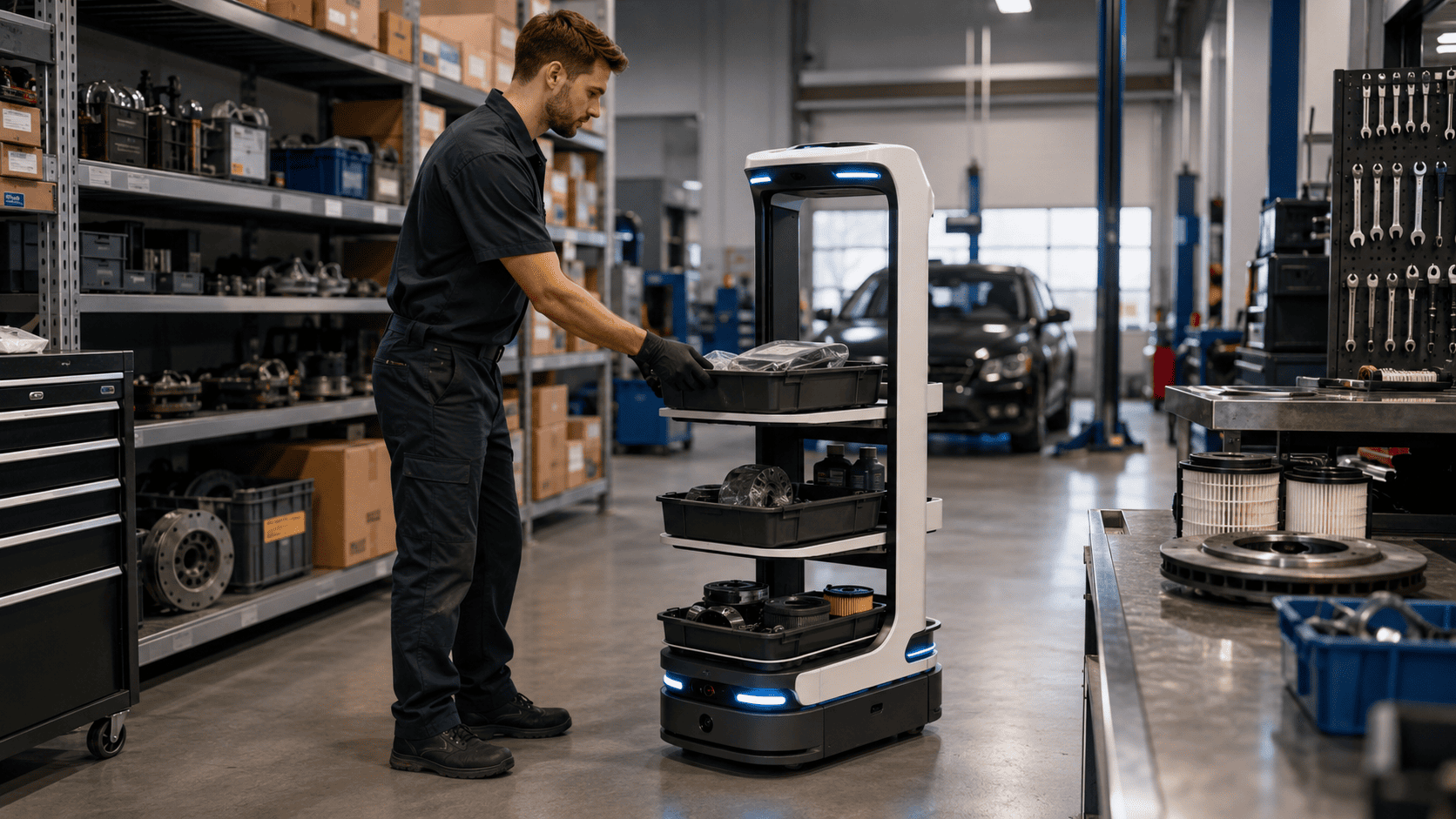
An AMR can handle scheduled or on-demand deliveries between the parts room and drop off points near service bays. Employees load the robot with labeled parts, select a destination, and send it through the facility. The robot handles transport while technicians remain focused on repairs and parts employees continue picking, receiving, and organizing inventory. When technicians know parts will arrive at a designated location without requiring another employee to leave a work area, repair orders can move with fewer interruptions.
Moving Heavy and Awkward Components
Automotive parts like tires, containers, boxes, and batteries could be heavy and difficult to carry. Hence, moving them manually can require carts, lifting, or multiple employees.
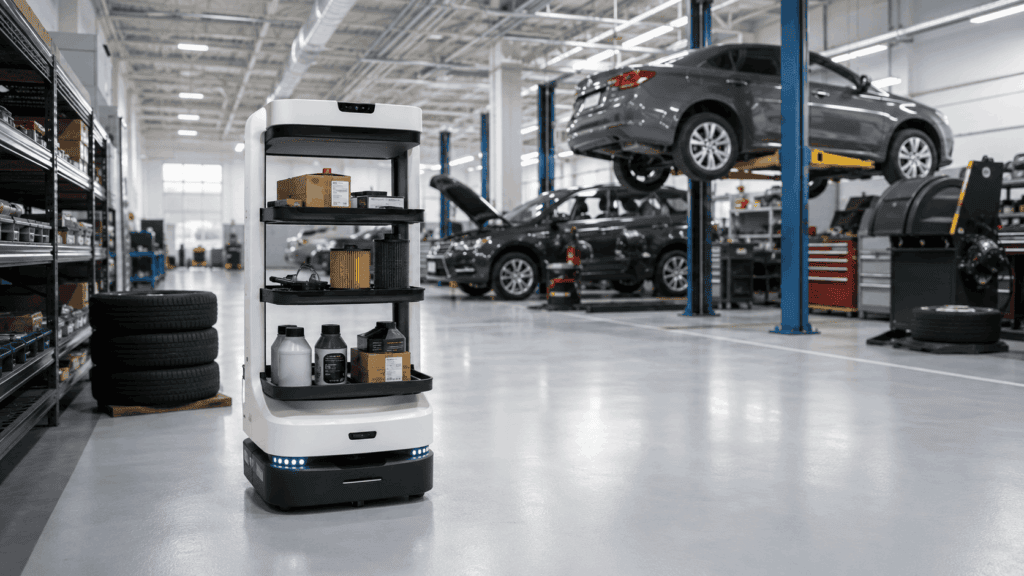
A properly selected industrial AMR can transport heavier loads between receiving, storage, service, and staging areas. This reduces the need for workers to push loaded carts through active workspace and creates a consistent method for moving components that don’t fit a traditional conveyor system. The robot does not replace safe loading procedures or employee oversight. Workers still inspect, identify, secure, and unload materials, but spend less time moving them across the building.
Connecting Receiving to the Point of Use
Material flow begins before a part reaches the counter. Incoming shipments must be unloaded, checked, labeled, entered into inventory, and moved to storage or directly to a repair area. In a busy dealership, collision center, fleet facility, or automotive plant, this can create congestion near receiving.
An AMR can move totes, cartons, or secured components from receiving to storage zones. Priority parts can go directly to a staging location for an active repair order, while routine stock is delivered to shelving areas for put-away. This creates a more organized handoff between receiving and inventory employees. The same approach is used for refills and maintenance. Filters, fluids, supplies, and fasteners can move from bulk storage to point-of-use locations on planned routes. Instead of waiting for a bin to become empty, the operation can keep essential materials closer to technicians.
Improving Returns and Reverse Logistics
Automotive operations also manage materials moving in the opposite direction. For example: cores, warranty parts, damaged components, incorrect orders, reusable containers, recycling, and customer returns must be identified and routed correctly. Without a clear process, these items can collect near service bays, or behind the parts counter, creating clutter and increasing the chance that a warranty item or return shipment is misplaced.
An AMR can move returned goods to the designated locations without heavily relying on manual cart movement. Compared to a fixed conveyor that is not flexible, an AMR’s route can be adjusted as the workflow changes.
Adapting Without Fixed Infrastructure
Although conveyors can move materials efficiently, they require permanent floor space and are difficult to change after installation. Automotive facilities often have vehicle lanes, lifts, toolboxes, and layouts that change as equipment or work volume changes.
AMRs have a flexible point-to-point option which means they can travel between defined destinations without requiring a conveyor through the shop, and routes or drop-off locations can be updated as the facility changes. A business can start with one high-frequency route and expand after measuring the results.
The first workflow might connect the parts department to the main service area. Later phases could add receiving, the body shop, tire storage, warranty returns, or dock deliveries. This allows the business to automate repetitive movements without redesigning the entire facility at once.
Building the Workflow Around the Operation
A successful deployment begins with the workflow. Leaders should identify what is being moved, how heavy it is, how often the trip occurs, where it begins and ends, and what causes the most delay. Along with that, they should review aisle width, doors, ramps, vehicle traffic, tight turns, charging locations, and employee interaction points.
The best starting routes are repetitive, predictable, and measurable. Examples include parts-counter-to-bay delivery, receiving-to-storage transport, tire or battery movement, supply replenishment, and warranty-return collection.
As a result, parts employees spend more time managing parts, technicians spend more time repairing vehicles, and materials arrive closer to when are where they are needed. By moving beyond the traditional parts-counter model, automotive businesses can create a safer, more consistent, and more adaptable material-handling workflow.
Connecting Automotive Material Handling to AMR Automation
A better material-handling workflow does not happen by accident. It starts by understanding where parts, tires, batteries, tools, supplies, cores, and returns move every day. Once those routes are clear, automotive businesses can decide which movements should stay manual and which ones may be ready for automation.
For many shops, the best first step is not to automate the entire facility. It is to start with one repeated movement, such as parts-counter-to-service-bay delivery, receiving-to-storage transport, tire movement, or warranty-return collection. After that workflow is tested and measured, the business can expand automation into other departments.
K&L Supply helps automotive and powersports businesses understand the equipment, layout, and workflow needs inside real service operations. ShopProBot builds on that support by helping businesses explore autonomous mobile robot solutions for material movement, delivery, and facility automation.
If your facility is trying to reduce walking, improve parts flow, support technicians, or move materials more consistently, AMR automation may be a practical next step.
Related Reading: Learn more about how autonomous mobile robots are improving warehouse and material-handling operations in ShopProBot’s guide: How Autonomous Mobile Robots Are Reshaping Modern Warehouse Operations.
Frequently Asked Questions
What is automotive material handling?
Automotive material handling is the process of moving parts, tires, batteries, tools, supplies, cores, returns, and other materials through a facility. This can include movement between receiving, storage, the parts counter, service bays, body shop, staging areas, and shipping.
Why should automotive businesses improve material flow?
Poor material flow can cause technicians to wait, parts employees to make repeated trips, and service jobs to take longer. Improving material flow helps the shop reduce delays, save employee time, and create a more organized process.
Can AMRs help move parts in an automotive shop?
Yes, AMRs can help move parts between the parts department, warehouse, service bays, receiving areas, and staging locations when the workflow and facility layout are planned correctly.
What is a good first workflow to automate?
A good first workflow is usually simple, repeated, and easy to measure. Examples include parts delivery from the parts counter to service bays, tire movement from storage to the mounting area, receiving-to-storage transport, or warranty-return collection.
How do K&L Supply and ShopProBot work together?
K&L Supply understands the needs of automotive and powersports service operations, including equipment, facility layout, parts departments, and shop workflows. ShopProBot supports these operations with AMR solutions that can help move materials more efficiently across the facility.