
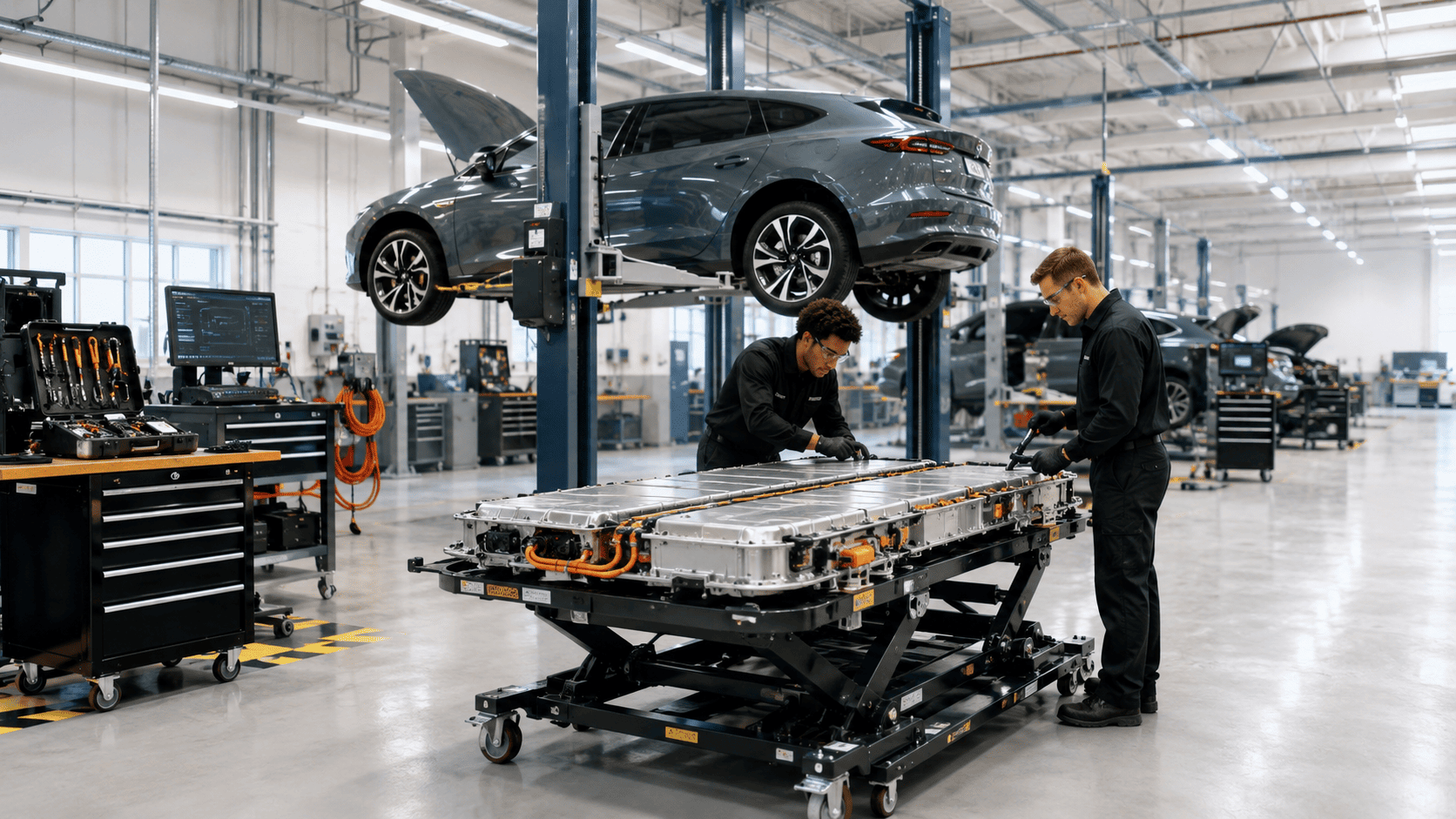
How to Prepare an Automotive Shop for EV and Hybrid Vehicle Service
EV and hybrid vehicle service requires more than purchasing a battery cart or powertrain lift. A complete shop-readiness plan should include trained technicians, current vehicle-specific service information, high-voltage safety procedures, a controlled work area, suitable battery and component-handling equipment, and a defined workflow for moving vehicles, tools, parts, and removed components through the facility.
K&L Supply has supported professional shops since 1968, beginning as a local repair business in Santa Clara and growing into an automotive, powersports, and industrial equipment partner. That service-bay background shapes a practical approach to EV readiness: prepare the people, control the work area, choose equipment for the components being handled, and plan how tools and materials will move through the facility.
EV-Readiness Essentials
|
What Does EV Readiness Mean for an Automotive Shop?
EV readiness is the ability to receive, inspect, diagnose, service, and move an electrified vehicle and its components through the shop using trained personnel, documented procedures, suitable equipment, and a properly prepared work area. The exact requirements depend on the vehicle brands, repair types, and high-voltage tasks the shop plans to support.
A complete readiness plan should address:
- Technician training and authorization
- Vehicle-specific procedures and service information
- Electrical safety practices and personal protective equipment
- Bay layout, access control, and emergency planning
- Vehicle lifting and battery or powertrain handling
- Storage and staging of removed components
- Movement of tools, parts, and supplies
- Documentation, inspections, and continuous improvement
What Training and Safety Procedures Are Needed for EV Service?
Work on or near an EV or hybrid high-voltage system should be performed only by personnel with appropriate training, tools, information, and authorization. A shop should define which employees may perform high-voltage work and which employees may work only on de-energized or non-high-voltage systems.
1. Technician qualification
Provide role-appropriate EV and hybrid training before technicians perform high-voltage inspections, isolation, testing, removal, or installation work.
2. Vehicle-specific service information
Use the current vehicle manufacturer procedure for identification, isolation points, required wait times, verification steps, lifting locations, battery support points, and removal methods. These details can vary significantly by vehicle.
3. High-voltage isolation
Establish a documented process for identifying, isolating, securing, and verifying the condition of the high-voltage system according to the vehicle manufacturer’s instructions and applicable workplace requirements.
4. PPE, insulated tools, and test equipment
Select and inspect protective equipment, insulated tools, and electrical test equipment according to the specific task, the vehicle manufacturer’s procedure, equipment instructions, and applicable workplace requirements.
5. Damaged-vehicle escalation
Create a separate response procedure for vehicles with suspected battery damage, flooding, overheating, smoke, unusual odor, or collision damage. These vehicles should not be treated as routine service work.
How Should an EV Service Bay Be Prepared?
The service area should provide a controlled, stable, and unobstructed environment for the vehicle, technicians, and handling equipment. The appropriate layout will depend on the vehicle, battery dimensions, lift type, equipment footprint, and manufacturer procedure.
- Use a hard, level floor suitable for the vehicle and handling equipment.
- Maintain clear travel paths for vehicles, carts, lifts, and emergency access.
- Provide enough room to position battery and powertrain equipment without congestion.
- Mark or barrier the controlled work zone and define who may enter it.
- Designate locations for tools, PPE, warning devices, and service information.
- Plan where a removed battery, drive unit, or other heavy component will be placed.
- Separate replacement parts from removed or potentially damaged components.
- Define a staging area for disabled vehicles and a response procedure for suspected battery damage.
- Confirm that doors, ramps, aisles, and floor conditions are compatible with the equipment being used.
What Equipment Does an EV-Ready Automotive Shop Need?
Equipment requirements depend on the vehicle brands and repairs the shop intends to perform. Common needs may include manufacturer-specified diagnostic equipment, electrical test tools, PPE, insulated tools, warning barriers, suitable vehicle lifts, battery-handling carts, powertrain lifts, and equipment for moving heavy components through the shop.
Support EV Battery Service With the K8000
Large underbody battery packs require stable support during removal, transport, and service. The K&L Supply K8000 EV Battery Service Cart is designed to accommodate EV batteries of different sizes and support multi-brand service operations.
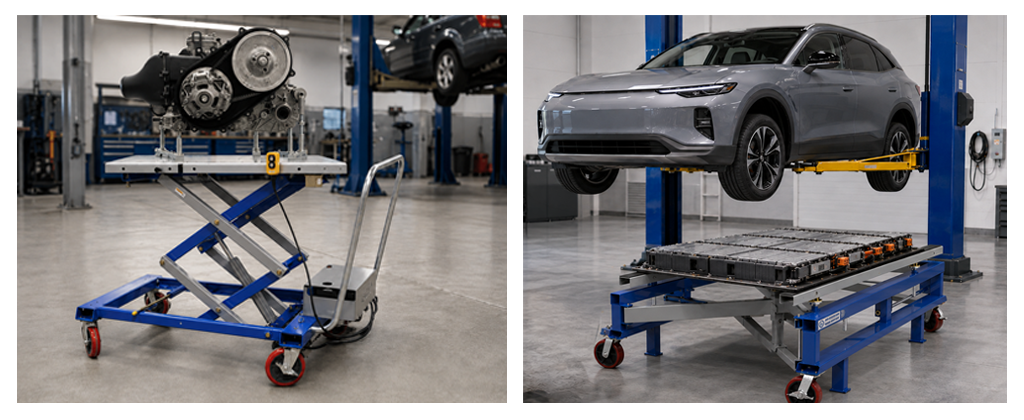
| K8000 specification | Article value |
|---|---|
| Rated capacity | 3,300 lb |
| Adjustable width | 16.5–62.5 in. |
| Application | EV battery removal, support, and transport |
| Positioning features | Adjustable upper rails, hand brake, and locking casters |
The cart does not replace OEM procedures or load calculations. Before use, technicians should verify the battery’s total weight, dimensions, center of gravity, support locations, balance, and the vehicle manufacturer’s removal procedure. The load should be completely lowered before the cart is moved, as directed by the equipment instructions.
Prepare for Powertrain and Heavy-Component Work With the K1700
EV and hybrid repairs may also involve electric drive units, engines, transmissions, fuel tanks, and chassis components. The K1700 Powertrain Lift provides a mobile, adjustable platform for removal and installation work across conventional, hybrid, and electric vehicle applications.
| K1700 specification | Article value |
|---|---|
| Rated capacity | 2,400 lb |
| Minimum / maximum height | 21.5 in. / 78 in. |
| Table width | 36 in. |
| Operation | Electric over hydraulic |
| Mobility and control | Locking casters, remote control, and safety locks |
For mixed-service facilities, this versatility can support conventional, hybrid, and electric vehicle work without limiting the equipment to one repair category. Operators should center the component over the lift, use the required adapters, fully lower it before movement, and follow the vehicle manufacturer’s service procedure and the equipment manual.
How Should Parts, Tools, and Components Move Through the EV Bay?
EV readiness also requires planning how tools, parts, PPE, and replacement components reach the controlled work area without creating unnecessary traffic or interruptions. For facilities with repeated indoor delivery routes, an autonomous mobile robot can be considered as an optional workflow improvement.
Through ShopProBot, K&L Supply’s robotics subsidiary, shops can explore the JOY6 autonomous mobile robot for repeated indoor delivery routes. The JOY6 supports loads up to 661 pounds, uses visual and laser SLAM navigation, and offers delivery and repeating-cruise modes. Its sensor package includes LiDAR, RGBD cameras, and collision switches for obstacle detection.
A properly deployed JOY6 can move parts bins, tools, and supplies between storage, the parts department, and designated service-area drop-off points. Deployment should be based on a site review of floor conditions, aisle clearance, traffic patterns, loading methods, docking locations, and expected payloads. The article source specifies flat, smooth indoor surfaces, approximately 23.6 inches of path clearance, and no operation on wet floors.
How Should Parts, Tools, and Components Move Through the EV Bay?
Use this checklist during a facility assessment or before expanding the types of EV and hybrid repairs your shop accepts.
| Readiness area | Questions to answer |
|---|---|
| Technician training | Who is qualified and authorized to perform high-voltage work? |
| OEM information | Are current procedures available for each vehicle and repair type? |
| Electrical safety | How will the system be identified, isolated, secured, and verified? |
| PPE and tools | Is the required equipment available, inspected, and appropriate for the task? |
| Controlled work area | Can access be restricted while high-voltage or battery work is underway? |
| Vehicle lifting | Are the lift, adapters, and lift points appropriate for the vehicle? |
| Battery handling | Can the battery’s weight, dimensions, balance, and support points be accommodated? |
| Component staging | Where will removed batteries and powertrain components be placed? |
| Material flow | How will tools, parts, and replacement components reach the bay? |
| Damaged vehicles | What is the escalation procedure for suspected battery damage or thermal events? |
| Documentation | Are training, inspections, procedures, and completed work documented? |
| Emergency planning | Do employees know how to respond, evacuate, and contact appropriate support? |
Build the EV-Service Workflow Before the Vehicle Arrives
A practical EV program combines trained technicians, documented procedures, controlled work areas, suitable component-handling equipment, and efficient material flow. The objective is not simply to add EV equipment; it is to create a safer, more organized service process for the changing vehicle mix entering today’s shops.
- Define the vehicle brands and repair types the shop plans to support.
- Review OEM procedures and determine technician-training requirements.
- Assess the bay, floors, clearances, access control, and emergency routes.
- Identify required PPE, test tools, diagnostic equipment, and warning devices.
- Verify component weights, dimensions, support points, and lifting locations.
- Select handling equipment appropriate for the planned applications.
- Establish battery and heavy-component staging locations.
- Document routine service and damaged-vehicle procedures.
- Conduct a trial workflow before accepting customer work.
- Review the process after initial jobs and make improvements.
Frequently Asked Questions
1. What does EV readiness mean for an automotive repair shop?
EV readiness means having the trained personnel, service information, safety procedures, work areas, tools, and component-handling equipment needed to work on electrified vehicles according to manufacturer procedures.
2. Do technicians need special training to service EVs?
Yes. Employees who work on or near high-voltage systems should have training appropriate to their role and should use the vehicle manufacturer’s procedures, required PPE, testing equipment, and insulated tools.
3. What equipment may be needed to remove an EV battery?
Requirements vary by vehicle, but a shop may need an appropriate vehicle lift, manufacturer-specified tools, electrical test equipment, PPE, and a battery-handling cart rated for the pack’s weight and dimensions.
4. Can the same equipment service conventional and electric vehicles?
Some equipment can support both. A powertrain lift, for example, may be used for engines, transmissions, electric drive units, EV batteries, and other heavy components when the application is within the equipment’s specifications.
5. How should a removed EV battery be moved?
The battery should be fully supported using approved support locations and handling equipment rated for its total weight. Follow the vehicle manufacturer’s removal procedure and the handling-equipment instructions.
6. Is purchasing an EV battery cart enough to make a shop EV-ready?
No. EV readiness also requires trained personnel, high-voltage procedures, suitable PPE and tools, a controlled work area, vehicle-specific information, component-staging plans, and emergency procedures.