
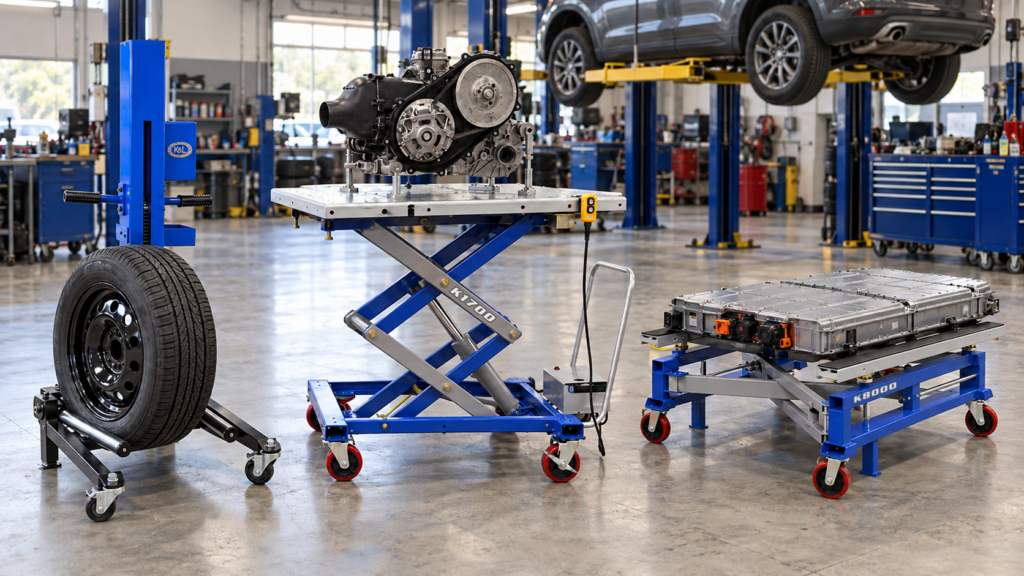
Professional Shop Workflow
A practical guide to handling wheels, powertrain assemblies, and battery packs from removal through reinstallation.
Heavy component handling is an important part of repair-shop workflow. A wheel needs support at hub height, a powertrain assembly needs careful positioning, and a removed EV battery needs a suitable support location. Planning each handling step helps technicians organize the job from removal through reinstallation.
These moments deserve attention because they connect the repair steps. Planning how a component will be supported, positioned, moved, and returned to the vehicle can help a shop reduce unnecessary handling and keep work organized.
What equipment helps shops handle heavy vehicle components?
A tire lift raises and positions complete wheel assemblies. A powertrain lift table supports and vertically positions large assemblies during removal and installation. An EV battery service cart supports and transports compatible battery packs after removal. The right choice depends on the task, component dimensions, approved support points, and equipment limits.
K&L Supply’s guides to the K2600 Tire Lift, K1700 Powertrain Lift Table, and K8000 EV Battery Service Cart explore these jobs individually. Together, they offer a useful way to examine the handling steps across a service department.
Start with the wheel work your shop repeats
For a shop servicing SUVs and pickups, wheel handling is a practical place to look for improvement. Getting a wheel off the vehicle is only part of the work. During reinstallation, the technician must also bring it to the correct height and align it with the hub.
A tire lift supports the assembly while its height is adjusted. That changes the task from holding the wheel’s weight by hand to positioning a supported load. K&L’s K2600 is one example of equipment designed for this role; it does not replace a tire changer or wheel balancer.
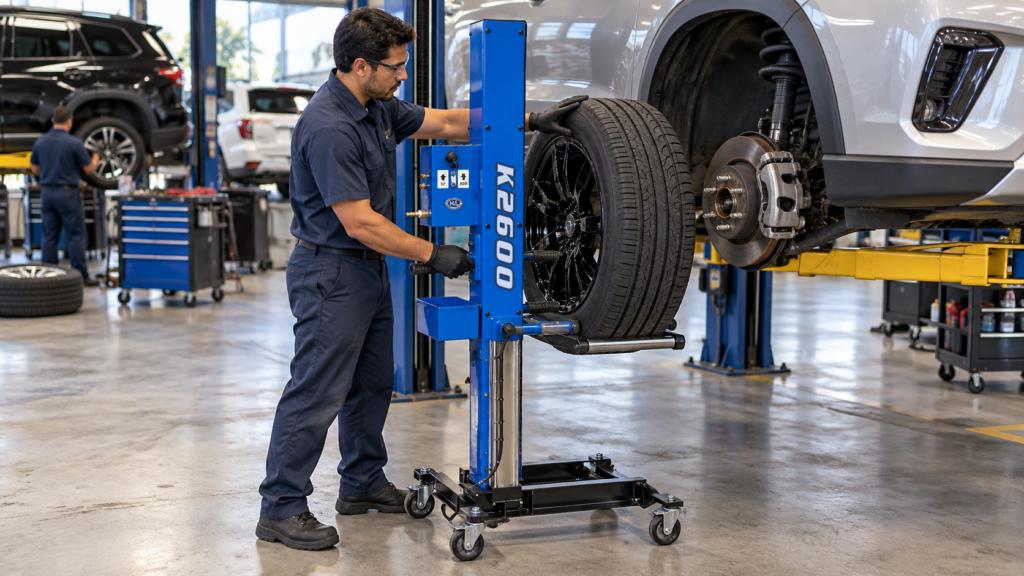
Imagine a shop with several SUV brake jobs booked for one morning. Its manager notices that technicians regularly pause other work to help hold wheels during installation. The shop introduces a suitable tire lift and reviews where it should be kept so it is available at the bay. The change to evaluate is specific: does supported positioning reduce the need for an extra pair of hands?
Read more: K2600 Tire Lift: A Practical Guide to SUV and Light-Truck Wheel Handling
The scenarios in this article are fictional examples for illustration, not customer case studies or measured results.
Plan powertrain support before removal begins
An engine, transmission, or subframe can present a different challenge from a wheel. Its shape may be irregular, its weight unevenly distributed, and its support locations difficult to reach. Successful handling starts with understanding those requirements before the assembly is released.
A powertrain lift table provides a platform beneath a compatible assembly. The important questions go beyond capacity: can the fixtures reach the required support points, does the equipment provide the necessary clearance, and can the assembly be positioned for reinstallation?
The K1700 Powertrain Lift Table illustrates this approach with a broad platform, controlled lifting, and table-positioning features. Appropriate fixtures and the vehicle manufacturer’s procedure remain essential; a broad table alone does not establish compatibility.
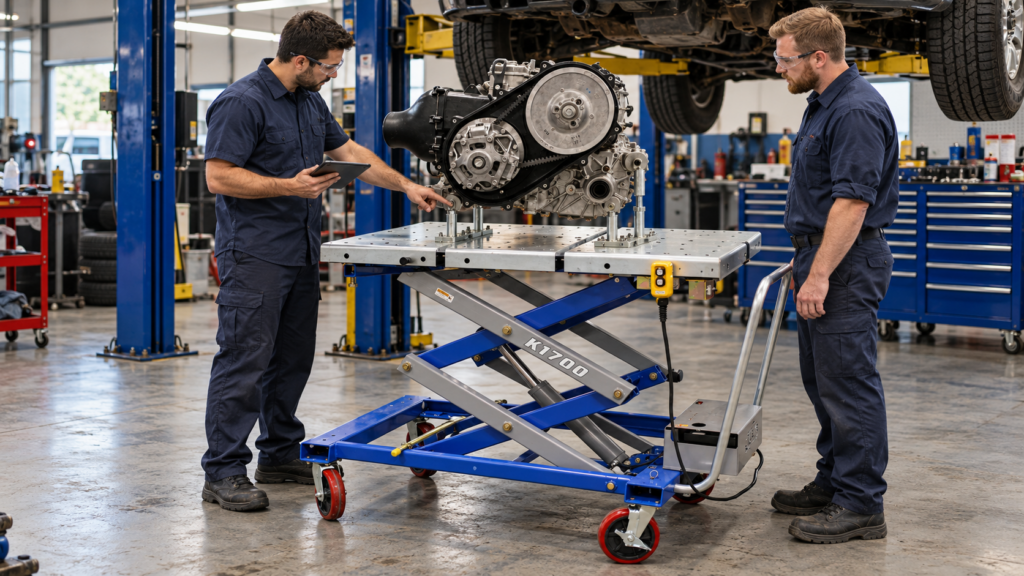
Consider an independent shop planning an engine-and-transmission assembly removal. The team maps the support and alignment requirements before the vehicle enters the bay. Where the service procedure permits, a compatible lift table can keep the assembly supported through more of the job. The manager tracks equipment changes and repositioning steps to see whether the revised setup actually improves the workflow.
Read more: K1700 Powertrain Lift Table: A Practical Guide to Engine, Transmission and EV Battery Handling
Decide where an EV battery will go after removal
Battery service adds an important planning question: what happens once the pack is out of the vehicle? A shop may have suitable lifting equipment but still need an appropriate support location for inspection or the next authorized service step.
A lifting table and a service cart have different roles. A table provides vertical lifting. A cart provides mobile support for a compatible load. The K8000 EV Battery Service Cart has adjustable support rails for this handling role; it is not a powered lift.
Do not assume that any lift table and battery cart can transfer a pack between them. Support geometry, access, working heights, securing methods, and the approved transfer procedure must all be compatible.
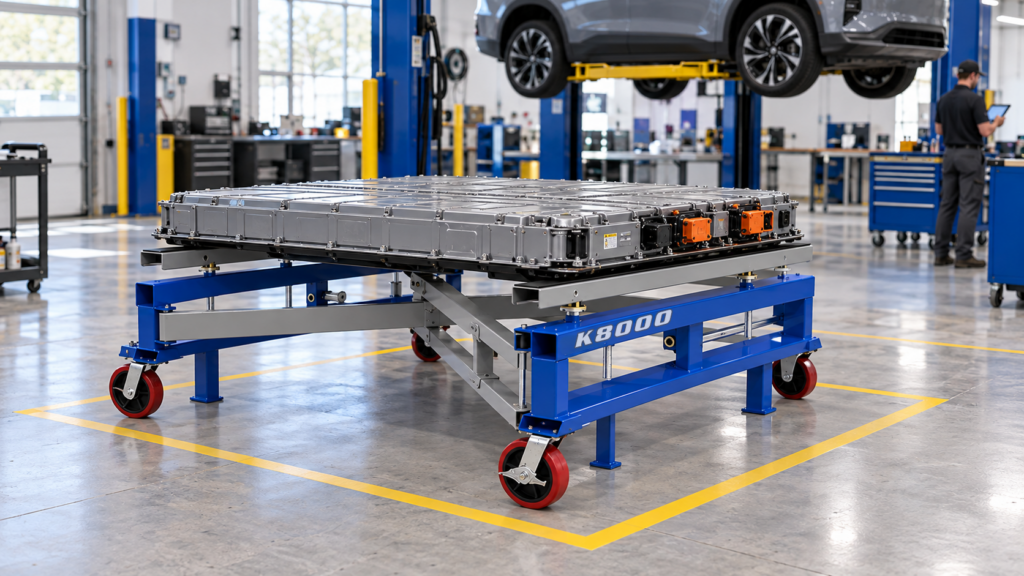
Imagine an EV service facility whose lifting table remains occupied by a removed pack while the team prepares further work. If the vehicle and equipment procedures allow a transfer to a suitable cart, the shop can plan a designated location for the pack and release the table for another compatible task. The potential benefit is equipment availability, subject to a verified handling plan.
Read more: K8000 EV Battery Service Cart: A Practical Guide to EV Battery Support and Transport
EV battery work requires qualified personnel and the applicable high-voltage service procedures. This article addresses workflow planning and does not provide battery-removal or electrical-isolation instructions.
Choose the improvement that matches your workload
A shop does not need to make every equipment change at once. Start by observing where handling interrupts the jobs you already perform. Ask technicians which components require awkward holding, which setups need repeated adjustment, and which equipment stays occupied while a job waits.
Use those observations to choose a focused improvement:
- Frequent wheel alignment and holding problems: evaluate a suitable tire lift at the service bay.
- Repeated support and positioning changes during assembly removal: evaluate a powertrain lift table and the required fixtures.
- Removed EV packs occupying lifting equipment: evaluate the approved support, transfer, and staging arrangements.
Before selecting equipment, verify the component’s weight, dimensions, center of gravity, and manufacturer-approved contact points. Check access around the vehicle and through the planned route. Equipment instructions and the vehicle service procedure determine whether the proposed setup is suitable.
Then measure the change using comparable jobs. Useful measures include time spent positioning a component, requests for a second technician, equipment waiting time, and the number of load transfers. Record what actually happens rather than assuming a faster lift automatically means a faster repair.
Common questions about shop handling equipment
How does a tire lift differ from a tire cart?
Can a powertrain lift table also handle EV batteries?
Does an EV battery service cart replace a lifting table?
Where should a repair shop begin improving its workflow?
Make the next handling step part of the plan
Better workflow begins before a component leaves the vehicle. Knowing how it will be supported, where it will go, and how it will return gives technicians a clearer plan for the whole job. Explore the three K&L guides above for a closer look at the equipment used at each stage.


